Chapter 7. Time of Change
Ha. We’re screwed. Damn.
Geonshin scratched his head and stood up.
To think he’d say it was me in a situation like this…
Team Leader Mo Seung-jin, once the ace of Section 1.
I thought he was fox-like. Was he actually a bear?
To come out and say it honestly at a time like this.
“You’re saying this was your idea?”
The Division 1 president looked at Team Leader Mo in disbelief, then turned his gaze and addressed Geonshin. Which made sense, since Section 7 belonged to Division 1.
“Pardon? Ah, yes. That’s right.”
The president regarded Geonshin with half-lidded eyes as if examining a curious object.
Watching this, Director Park Seong-gi couldn’t hold back and suddenly asked,
“Where did you copy it from?”
Sure, that’s an understandable suspicion. But—
“No. If I had to say I referenced anything, it would only be Alice in Wonderland, which you all know.”
“Really? You look like a temp. What school do you attend?”
Now isn’t the time to lie.
Even if he did, it would come out later anyway.
He had no choice but to answer honestly.
“…It’s the Department of Architecture at Gyehwa Junior College.”
“What? Gyehwa Junior College? Are you telling me we have a junior-college kid in our firm?”
Director Park glared at Director Yoo-uk as if he’d caught him.
Yoo-uk’s expression shifted to say, Here he goes again, this punk.
“Yeongjo Architects has internal rules, you know, and it looks like Section 7’s director openly violated them.”
“Ah, well…”
“Since when did our company become a place where any dog or cow can walk in?”
“What? Calling a person a dog or a cow. There’s nothing you won’t say, huh.”
“Then what about the top-university students who couldn’t get in because of that junior-college kid? They were lined up to come here.”
“Lined up for a part-time gig? Don’t be ridiculous.”
“Section 7 is impressive indeed—taking in a junior-college kid isn’t enough; you even use an intern’s idea as-is, for heaven’s sake.”
“Didn’t you watch the presentation? Isn’t the outcome what matters? …sir!”
“What do you think you’re doing in front of the president and division presidents? This project should be voided. If word gets out, what will people think? Get that temp out of here, now.”
Seriously… Should I sock him and quit?
Director Yoo-uk’s blood boiled, but he had nothing to say. Rules were rules, and he had in fact broken them.
Then—
“I decided that for a good idea, schooling and the like didn’t matter.”
Team Leader Seung-jin stepped forward. Director Park looked incredulous.
“What? What did you just say?”
“I knew he was from a junior college and still used him. So hold me responsible.”
“Mo Seung-jin, you…”
To Director Park, who’d once been in the same section, Mo was a thorn in the eye. Whenever they ran projects, the guy always beat him with better ideas. Even the team members reported key matters to Seung-jin instead of to him; days working with him had been an exercise in humiliation.
But Mo had fallen out of the president’s favor and been driven to Section 7; Park had been relishing watching him struggle lately…
“You’ve gotten bold, huh? Talking about taking responsibility in the design pool.”
“Director Park, you graduated from a provincial university too, didn’t you—but you’re here because your graduate school was in Seoul, right?”
“What!? You little—! How dare you—!”
But in the midst of the commotion, one voice settled it in an instant.
“Enough.”
At President Lee Sang-man’s single word, the cauldron of a room froze over.
Only Director Park, face bright red, continued to glare at Seung-jin.
“All right. If the idea came from that young man’s head, let’s at least hear what he intended.”
“President? You really mean to hear out a temp?”
At the executives’ retort, the president furrowed his brow deeply.
It said: Shut up and listen.
The Division 1 president who’d spoken up snapped his mouth shut as if swallowing thorns.
And so, with every eye on him, Geonshin—
he had to explain the mirror ornamentation. If he couldn’t persuade them, the Becoming Alice project would plainly run aground.
Ha… In this era, I have to give a presentation on the truth of architecture? It’s not even the time I lived in.
Any given -ism, with time, suffers excess and slips into mannerism. History had proven this, and it always repeated.
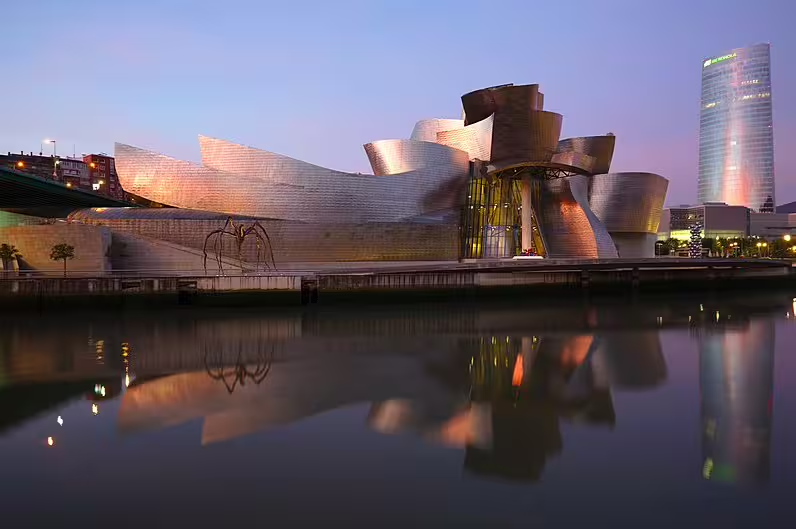
Excess ornamentation called forth Minimalism, but as time passed, architects bored by that overly austere movement gravitated toward Deconstructivist architecture.
Soon cities would be filled with flamboyant buildings that ignored the dictum “ornament is a crime,” but he couldn’t exactly say, I’ve seen it all in the future.
Then only one path remained: prod change in the domestic mainstream of architecture which was now at the tail end of Minimalism.
“I too like touring buildings, like you do, President. Of course I haven’t yet seen famous buildings overseas in person, but I’ve often substituted by visiting buildings here.
Especially those made by Yeongjo Architects.
I particularly loved the ones you designed.”
At those words, Director Park snorted through his nose.
A brat trying to butter him up already. Think that’s going to work?
“I can’t claim to grasp the essence of architecture you said you felt abroad, but I could feel how warm and mellifluous that space was.”
“Ho-ho. Thank you.”
“But the problem is…”
A mere temp, to the president…
Problem?
At Geonshin’s words, the room seemed to freeze.
“The problem began when I stepped back outside. Leaving such a wonderful building behind, I found people gathered in front of a small building right next door. I thought, ‘Why aren’t they feeling this good space… what are they looking at?’ So I walked over to that building, grumbling.
I wanted to check. To see what was holding people there.
Sure enough, that plain, unimpressive building had a mural painted on it. Paintings by who-knows-who all over the wall… like messy graffiti. I wondered why they hadn’t scrubbed it off. But I realized it at once.
People were standing there taking photos and viewing it like art. From a mother holding a child for a snapshot to a grandfather seated on a chair in front of the corner store across the way, admiring the picture.
Everyone was delighted. While looking at ornamentation that architects loathe.
It turned out the famous spot in that alley wasn’t House for a Poet. It was the building with the mural.
That shabby building turned a narrow, run-down alley into a gallery. It was something even an architect couldn’t do.
It made me think. Is what’s called ‘good’ truly good? Or is what people love what’s really good?
Is it really all right for architects to label ornament that people genuinely enjoy as a crime at their own whim? With that in mind, we pursued this project.”
The Division 1 president, who had been watching the president’s face, cut in.
“What are you even saying? Swept the architecture awards here. It’s not something for a junior-college kid like you, from who knows where, to judge. This project ends here. That’s enough!”
Director Yoo-uk bowed his head as if all was lost, and Team Leader Seung-jin smacked his lips bitterly.
But then—
“Ho-ho-ho-ho! Yes. That’s it! I remember.”
When President Lee let out a belly laugh unlike any before, people were thrown into confusion. Was he laughing because it was so absurd?
But what he said diverged from their expectations.
“In fact, there’s a coda to that story about my Switzerland tour. Yes. Hearing this brings it back.
My wife and young son came along at the time. Even before we left, I was thrilled to show them the buildings I loved. The moment we arrived and dropped our bags, I took them there, thinking how wonderful it would be if they could feel what I felt.
I explained till my mouth went dry and told them it was beautiful, but my wife and son had no interest whatsoever. They even said I was lying. They asked what on earth was beautiful about it, how a bare, empty room could have anything. They preferred the candy shop across the way… a strange building with big candy models plastered all over the wall.
So in the end we wandered separately. Until we returned to Korea. Ho-ho-ho-ho!”
“P-Pr—President…”
At President Lee’s laughter, Geonshin smiled. It was the result he’d anticipated.
He knew that the buildings President Lee would produce afterward would slowly change. It would be the starting point of a small shift in contemporary architectural history.
Perhaps from this time, President Lee began wrestling with the future of architecture. Of course, only Geonshin, who had come from the future, knew the content of that struggle.
Surely around 2002, this project might reach the president…
The idea had started from there.
“I liked today’s design pool very much. It even brought back old memories. Perhaps we, too, need to change a bit now.”
Flustered, Director Park Seong-gi said,
“President, surely you’re not approving that project?”
Look. The tide has already turned.
Having taken the president’s temperature, the division presidents pivoted quickly, so quickly it was ludicrous given their reactions just moments before.
“Come on. What’s the harm in one small bridge? And the client hasn’t even given the green light yet. For now, move it forward.”
“But…”
“Quiet. That’s enough. We have the next item.”
And so, amid reversal, Section 7’s Becoming Alice project passed the design pool.
And until they went to the Korea Institute of Science and Technology, it became a glorious “Do Not Leak Externally” document, a clear proof that the higher-ups regarded this job as a valuable build.
The directors of each section explained Section 7’s presentation to their teams and instructed them to adopt similar tactics in the next design pool for in their eyes, Section 7’s presentation had truly been an innovation.
Of course, Director Park Seong-gi’s Section 1 did not receive this notice.
At least until his anger cooled, it seemed unlikely Section 1 would be accepting any newfangled things.
In any case, just as Assistant Manager Su-min had hoped, perceptions of Section 7 began to change little by little.
But they immediately began other preparations: to face the facilities chief at the Korea Institute of Science and Technology who was no doubt already set on awarding the bridge construction to Sam-in Architecture.
“All right. Now we go to the Korea Institute of Science and Technology.”
A representative Deconstructivist work.

Leave a Reply