Chapter 6. Ornament and Crime
The power of a rendered image was truly immense. Geonshin could fully feel the energy in the conference room. In the time period he came from, a presentation like this was commonplace, but in the past, when people were unfamiliar with computer programs, this presentation was on a completely different level.
“That bridge… if we were to actually build it, wouldn’t the cost be enormous? Is it even feasible? And wouldn’t that kind of broken shape be difficult to construct?”
Director Park Seong-gi suddenly threw out the question.
He sensed that if things went on like this, their own project would be completely overshadowed. Seeing an opening, the other directors began chiming in.
“It sounds impressive, but if it can’t be built, what’s the point?”
“Is there even a carpenter who could make that?”
“In the end, how’s that any different from paper architecture with buildings that can’t actually be constructed?”
That was when Geonshin walked over to the model stand and pulled away the cloth covering it.
The bridge model showed no holes or cracks. The connecting bridge fit seamlessly with the details of Buildings 7 and 8, as though it had been part of the structure from the very beginning.
It wasn’t an expensive steel structure, either. Supported by neat, unobtrusive slender columns that didn’t intrude onto the road, the design was modest and well-balanced.
“Hey! The model’s different from the image! What’s going on here?”
“Knew it. Of course. Like this could ever be built.”
While the directors voiced fiery complaints, Team Leader Seung-jin poured fuel on the fire.
“Mirrors. It’s mirrors.”
“What!? Mirrors? You’re saying that’s made with mirrors?”
“No way! Mirrors don’t look like that!”
“Is this presentation a joke to you?”
The directors’ murmurings made even the company executives tilt their heads. The way the others reacted—like hyenas who had just found prey—was proof they had scented weakness. Once an opening appeared, the kill had to be finished. That was the ecosystem of the design pool.
But Team Leader Mo Seung-jin was unbothered. He pulled out a large board that had been hidden behind him. The board was covered with mirror fragments arranged like pieces of a mosaic. It was a reproduction of the broken effect they had designed for one side of the bridge’s wall. His hands, covered in numerous bandages, made it obvious he had worked on it himself.
“One side of the wall would have pixel art made from mirrors. As you can see, there’s no need to punch holes in the wall, so there’s nothing impossible about the construction.
In fact, it may be easier and cheaper to build than any bridge you’ve seen before—cheaper even than what the client requested.”
Team Leader Seung-jin carried the board toward the directors, stopping in front of Director Park Seong-gi and lifting it up.
Park Seong-gi flinched.
‘What the—this…!’
His own reflection was visible in the mirror fragments. It was as if his image had been caught in the broken fissure leading to another dimension.
The effect gave the illusion that he was standing inside a hidden space beyond the board.
The look of surprise on his face was almost like that of someone spotting a rabbit.
The same was true for the other directors who saw the board in person. It was as if a rabbit were hopping around the conference room, beckoning them to follow.
For just a brief moment, they had become Alice.
Shaken by the impact of the 7th Division’s presentation, people’s flustered expressions were plain to see. Director Yoo-uk finally allowed himself a smile.
The highest level of a presentation was an experience—something you could see with your eyes and hear with your ears.
‘What the hell happened to them all of a sudden?’
An unreasonable anger surged inside Park Seong-gi. How could a garbage division like this suddenly show up one day with a plan like this?
The value of the design, in terms of constructability, was so outstanding that even he could think of nothing greater. His anger was born from having no choice but to acknowledge it. He looked around at Team Leader Seung-jin and the rest of the 7th Division.
‘Did they hire a CG company or something? And where the hell did the rabbit story come from all of a sudden?’
Even though the real mastermind, Geonshin, was sitting right there, Park Seong-gi still couldn’t figure out how it had all come together. In his worldview, it was inconceivable that someone like Geonshin—an unknown to him, let alone the 7th Division—had played any role.
Assistant Manager Su-min gave Geonshin a thumbs up.
“Mr. Geonshin, good work. The reaction’s way hotter than I expected.”
“Not yet.”
Geonshin looked calmly toward the company president. The presentation’s success ultimately depended on whether this design would be taken to the client.
The real issue was the choice of the decision-makers at Yeongjo Architecture, who were known for being conservative.
“Team Leader Mo Seung-jin.”
At President Lee Sang-man’s words, the previously chaotic meeting room fell silent. Everyone’s attention turned to the president’s mouth.
Geonshin thought to himself:
Even for President Lee Sang-man, who had been in architecture for decades, this was surely a first-time experience. Some people, when encountering something new, would raise their hand in favor of its freshness; others would dismiss it as a contradiction to established norms.
Which kind of person was President Lee?
‘The … strictly speaking, it could easily feel like the latter… something that disrupts the established order.’
Until the mid-2000s, architects held a certain belief: a distaste for unnecessary ornamentation, and an allergic reaction to bending or curving straight lines without cause.
This mindset came from the philosophy of the earliest modernist architects which is something they revered as truth.
From Adolf Loos.
In his 1900 essay Ornament and Crime, Adolf Loos famously said, “Ornament is a crime.” The tailor shop he built in 1910 had no ornamentation at all—not even the horizontal bands that usually decorated windows. It was so unlike the prevailing styles that people mocked it as “the house without eyebrows.”
It was, after all, an era of excessive ornamentation. Royals and nobles piled decoration upon decoration to flaunt their power. What kind of cityscape could result but one mired in mannerism?
Adolf Loos sought to break free from such excess, proclaiming a new aesthetic standard: discard architectural waste, and pursue what is “proper, solid, and precise.”
Revolutionaries who shift paradigms leave a deep mark on their fields.
The senior executives and directors in this very conference room had been influenced by such ideas. To them, a design made of mirrors was something they had been taught to regard as a crime.
All eyes that had been on the big screen now turned toward President Lee Sang-man.
Director Park Seong-gi studied the president’s face carefully. He was too inscrutable to predict what he might say.
‘Sure, maybe the rest of us were taken in, but there’s no way something like mirror ornamentation will sway the president. This project’s dead.’
The president’s reaction seemed to confirm Park Seong-gi’s expectations.
“Hm, yes. There was a time I went on an architectural study tour in Switzerland. I’d wondered what it would feel like to see in person the buildings I’d only ever seen in photographs. It was like the excitement you feel just before opening a Christmas present.
And when I finally stood before that long-awaited building, I’ve never forgotten the sensation—the shiver I felt stepping into a noble, luminous space. It was like a poem.
If I think about why… it was because there was no gaudy ornamentation. There was nothing but pure walls. Those pure walls divided the space, and the warm sunlight cast shadows across them—no wallpaper was needed. That dignity enveloping people… it felt like I had reached the very essence of architecture.
That’s when I realized the direction Yeongjo Architecture should take. But this project is far removed from that. What do you all think?”
The executives nodded as they listened. As soon as the president finished speaking, even the directors who had been caught up in the magic of the presentation began to shake off the spell and return to reality.
Director Park Seong-gi rejoiced inwardly and glanced at Team Leader Mo Seung-jin. But Seung-jin’s expression didn’t change; he simply listened to the president’s words.
When the president finished, the executives joined in.
“That’s right. I enjoyed the presentation, but I don’t think that kind of mirror ornamentation fits with Yeongjo Architecture. It’s nothing more than a temporary illusion, a trick.”
“If other architecture firms saw it, they might think we’d compromised the purity of our design.”
“It was well-prepared, but I’m not sure it aligns with what we’re pursuing.”
Listening to his executives, President Lee Sang-man turned to Team Leader Seung-jin.
“Whose idea was this?”
It was perhaps the question everyone in the room most wanted answered. Whose mind had conceived this idea?
Naturally, the directors looked to Team Leader Seung-jin. There was some puzzlement. It was completely different from his usual style, but everyone acknowledged his ability to drive a project. They assumed even such a unique result must have come from him.
Team Leader Mo Seung-jin hesitated.
Could he really say it?
That they’d thrown this together with an intern’s idea because they were desperate? That once he heard it, it seemed decent enough, so he’d run with it? Could he say that in such a formal setting?
Geonshin was just as conflicted. His architectural skill was invisible to the eye, and right now he was just a 23-year-old part-time worker. If they honestly said the idea came from him, it wasn’t just him… they’d be inviting ridicule on the entire 7th Division. People would say, “It must have been bad if…”
And the biggest problem was that the 7th Division had broken company rules by officially involving Geonshin, a mere junior college student, in the design pool. Strictly speaking, it meant taking the risk of leaking information to an outsider.
Assistant Manager Su-min looked nervously at Team Leader Seung-jin. Depending on what he said, the already rock-bottom image of the 7th Division could be dragged down even further.
But for whatever reason, Seung-jin chose to tell the truth.
“This was… the idea of Mr. Na Geonshin. Of course, once I heard the concept, it was my decision to approve it.”
By revealing that it was Na Geonshin’s idea while also clearly stating that the responsibility was his, Team Leader Mo Seung-jin laid it out plainly.
What?
Na Geonshin? Who’s that?
The room buzzed as everyone looked toward one corner. There they saw a young man sitting beside Assistant Manager Su-min, whose face had gone red.
The most surprised of all was Director Yoo-uk. Na Geonshin… that was the name of the intern he’d reluctantly brought in at a senior acquaintance’s request.
‘Damn. We’re screwed.’
Adolf Loos – Ornament and Crime
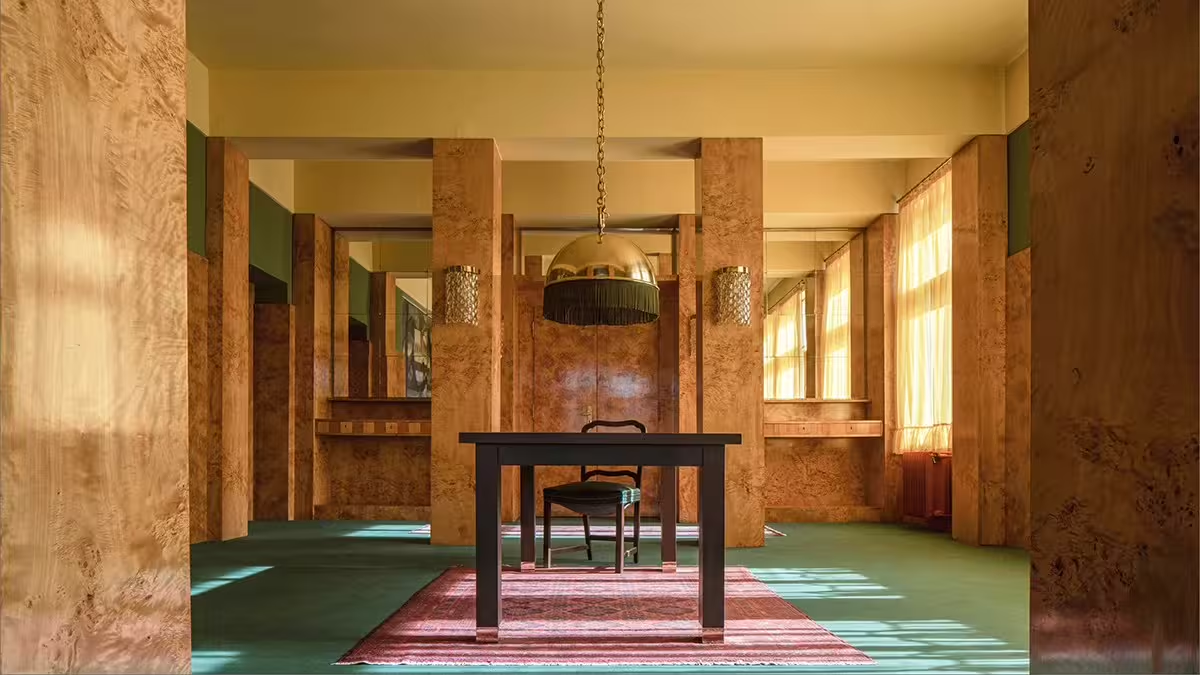
while the interest came from good layouts and how the rooms connect.
His bold message pushed designers to aim for restraint and long-lasting value.

Leave a Reply