Chapter 36. Memorial Park (追慕空園)
“Ha. This is really… something.”
Seung Yugyeol wore an awkward expression as he walked around with his stickers, judging the works one by one.
Two hours had passed since the judging began, but his stickers were still untouched.
Of course, it was true that the Korea Architecture Competition attracted high-level work. But if you compared it to a nationwide mock exam, only about the top ten percent was really worth looking at. The rest were more or less the same.
And this was after they had already filtered out half the submissions that did not even have the basics down.
From Seung Yugyeol’s perspective, it was unbearably dull.
Most of the entries simply reused ideas that already existed in other works or copied the discourse surrounding them wholesale. He often saw passages and concepts lifted directly from things the students had seen or read elsewhere.
There even seemed to be enough works copying Seung Yugyeol himself to fill an entire basket.
It had reached the point where he could barely tell whether this was the work he had just seen or whether that one had been this one.
“You know, I’d believe it if someone told me all of these were your works, Mr. Seung.”
“Hm? Ah, you’re here.”
The man who immediately recognized the boredom on Seung Yugyeol’s face was Professor Kim Gwangsu of the architecture department at Hankuk University.
He was three years Seung Yugyeol’s senior and a scholar renowned for his architectural discourse. His books were so well known that they were practically required reading for architecture students in Korea.
The two had known each other for years. Their busy schedules normally made it difficult to meet, but whenever they happened to run into each other at a judging event like this, they usually ended up drinking together through the night afterward.
“If you keep walking around with that bored look on your face and someone takes a picture, what are you going to do? It might end up in the book of award-winning works later.”
“I know. The problem is, I’m terrible at acting. Hahaha.”
“There are a few decent ones in the block next to this one. You won’t be bored the entire time.”
“Oh? Is that why all of Professor Kim’s stickers are still untouched too?”
“At least I can act with my face and maintain a poker face.”
“Always something to say.”
“Hahaha! Anyway, once the judging is over, let’s meet at the usual place.”
“Certainly.”
Watching Professor Kim grumble as he followed the judging route on the other side, it seemed he had not found anything especially worthwhile yet either.
Then it happened.
“Is this this year’s controversial work?”
He heard one of the judges murmuring from the opposite side.
‘Controversial work?’
Seung Yugyeol quietly moved toward the neighboring exhibition area and noticed several judges gathered together.
‘Why are they all gathered over there?’
Utterly bored, Seung Yugyeol left the works in front of him behind and wandered over.
Four judges were standing before a single entry.
They were so absorbed in whatever they were looking at that they did not even notice Seung Yugyeol approaching.
He looked over the judges’ shoulders to see what the work was.
There, instead of a panel, lay a single faded black-and-white photograph.
‘This is….’
A tiny ripple began in Seung Yugyeol’s eyes and spread outward in a large circle.
His gaze immediately shifted to the title of the work.
Entry No. 314 / Title: [Seocho-dong 1685-3]
‘Seocho-dong… Surely not.’
At that moment, Seung Yugyeol felt something violently shake the deepest reaches within him, a place that had never been touched before.
The shape and address of this site…
It boldly exposed the Sampoong Department Store disaster that everyone had been trying not to talk about.
‘Is this kind of boldness only possible because the creator is a student…? What was he thinking?’
The long rectangular panel was nothing more than a simple sheet of paper.
From what Seung Yugyeol could tell, perhaps out of concern that the paper might warp if spray adhesive were used across the entire surface, adhesive appeared to have been applied only to each corner.
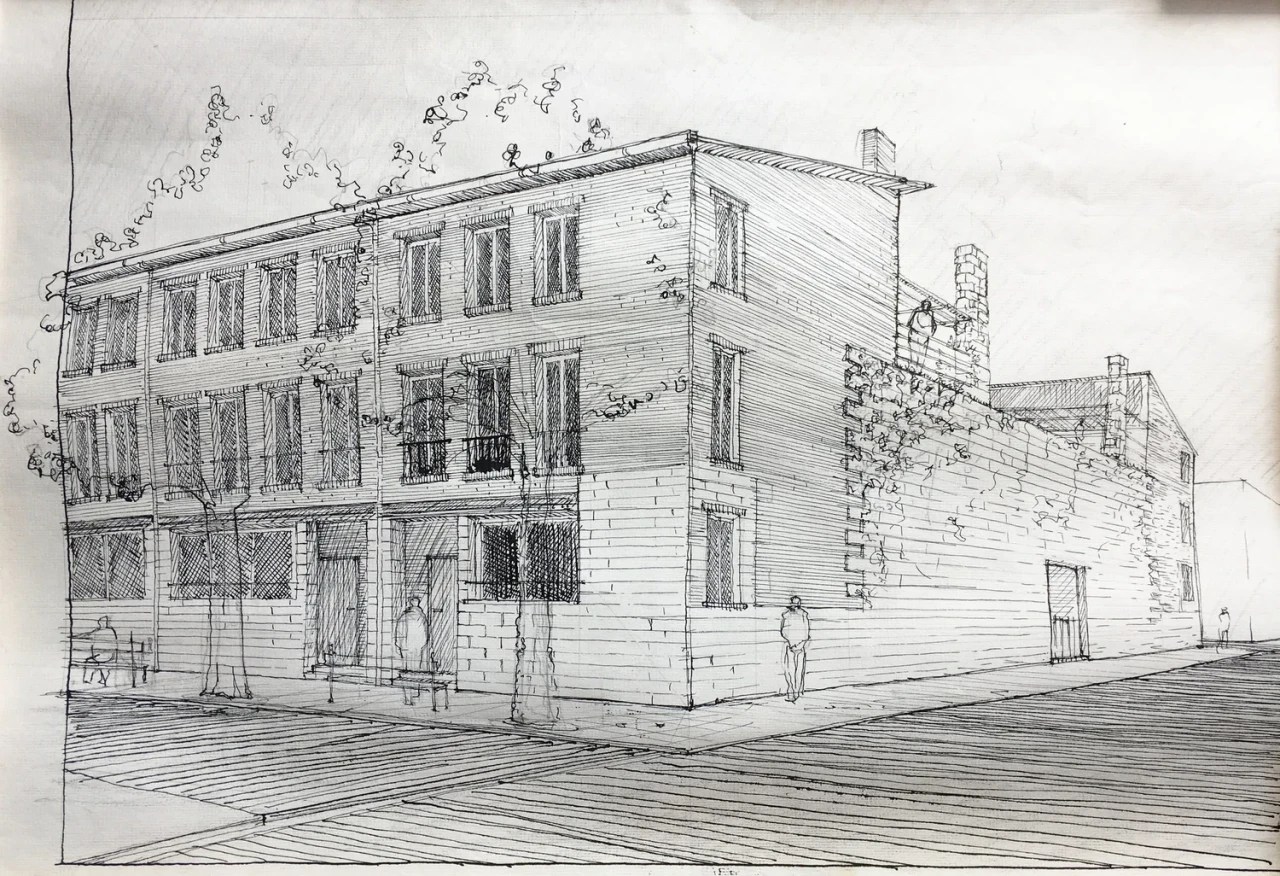
And on that white sheet of paper was a pencil dessin bearing the unmistakable traces of a human hand.
The true appeal of dessin was that, without color and using only pencil, one had to express texture, mass, form, volume, and even perspective.
It was completely different from the way color spread when a brush touched paper.
If the other panels had been created by controlling colors much like the spreading of paint from a brush, [Seocho-dong 1685-3] had built its form upward from the ground, one layer at a time, through overlapping pencil lines.
Seung Yugyeol could feel the entrant’s deep contemplation as he imagined him sitting before the blank paper, silently layering line upon line.
It felt like a silent protest.
‘This work is asking us a question… I can feel it.’
A rectangular plot of land, 270 meters wide and 90 meters long.
Geonshin erased the horrific site of a disaster created by human greed.
Then he erased the mixed-use apartment complex created by that same greed once again and returned the land to a place of remembrance.
Memorial Park.
He preserved only the exact footprint where Sampoong Department Store had originally stood, filling the rest of the land with a field of reeds.
The reed field served as a kind of boundary separating outside from inside.
Reeds changed their color according to the passage of time and the changing seasons. In warm seasons, they showed their green. In cold and chilly seasons, they offered warmth.
Through them, he expressed that a place of remembrance did not remain frozen in simple silence.
When the wind blew, the rustling produced as the reeds brushed against one another would allow visitors to briefly escape the noise of the city.
Hoping that sound would resemble weeping to some while bringing peace to others, he had drawn it painstakingly, one stroke at a time, layering pencil lines over one another.
‘The boundary formed by the reeds brings Sampoong Department Store to mind. The site of the disaster is clearly empty, yet you can still feel it. And when the wind blows, that boundary becomes indistinct again. The shape of this land isn’t fixed. More than that, the reeds almost seem to be moving right before my eyes.’
As Seung Yugyeol stared blankly at the panel, the rough strokes and hazy smudging made him feel as though he could hear the soft rustling from within the drawing.
And the field of reeds, seeming to sway whenever he took another step, appeared strangely mystical.
‘No, is this some kind of optical illusion? Am I the only one feeling this?’
It was not only Seung Yugyeol.
The longer the judges stared at the panel, the more impossible it became for them to escape its dreamlike sensation.
It was because of the technique Geonshin had used: sfumato.
Someone once looked at the Mona Lisa displayed at the Louvre Museum and said:
‘When I first saw the Mona Lisa, she somehow looked sad and lonely.’
‘Really? When I glanced at her without thinking, she looked like she was staring at me seductively.’
‘What are you talking about? When I went closer, she was smiling as though she were mocking me!’
Although it was a fixed painting, the Mona Lisa’s expression seemed to change endlessly depending on the viewer’s state of mind.
That came from Leonardo da Vinci’s ingenious method of expression.
Painters in Florence during the late 1400s had constantly wrestled with the question of how to make the figures in their paintings appear alive.
Da Vinci answered that question through the technique of sfumato.
It described a feeling of “vanishing like mist.”
A method of eliminating clear outlines.
Da Vinci was said to blur the outlines of his subjects by overlapping them with surrounding areas. If one looked at the boundaries around the Mona Lisa’s eyes and mouth, traces of intentionally softened contours could be found.
Depending on the viewer’s position or psychological state, those blurred boundaries could create different impressions and allow the viewer to perceive different expressions.
Of course, understanding something in theory and actually being capable of expressing it were two entirely different things.
But Geonshin had his Skill window, so that posed no problem at all.
His glowing hands displayed their full ability upon the paper as though he had borrowed Da Vinci’s talent itself.
Geonshin deliberately made the image on the panel more ambiguous and less distinct, creating the sensation that the reed field gently swayed whenever the judges moved.
The judges experienced an eerie sensation, as though they were faintly hearing the cries of reeds hidden within the wind.
Before anyone realized it, every judge had gathered before the same work to examine it.
Glancing to the side, Seung Yugyeol saw that even Professor Kim, who had been maintaining his poker face, no longer seemed capable of controlling his expression.
A complicated mixture of amazement and bewilderment showed plainly in the muscles of his face.
‘This… I’ve never experienced anything like this before. From a mere panel…’
Across the empty site of Sampoong Department Store, a long line cut through the land, with an offset gap opening at its center.
Visitors entering the memorial park from the boulevard after passing through the reed field were led onto a descending path.
At the point where that sloping path met the opening, a steel plate had been erected to reflect the person standing before it like a mirror.
And engraved upon that steel plate were the names of every victim.
Even the name Park Changmin…
By forcing visitors to see themselves reflected alongside the victims’ names, Geonshin had embedded a message into the memorial:
Along with remembrance, complacency toward safety could bring about yet another disaster at any time.
Because they had to prevent any more victims’ names from ever being added to that steel plate.
As Seung Yugyeol examined the work, he felt himself being drawn deeper into shock.
A massive memorial park in the heart of the city.
The courage to confront a disaster.
A sense of the problem meant to sound an alarm throughout society.
And on top of all that, the quality with which those ideas had been expressed.
His generation had also created panels like these entirely by hand.
There had been no enormous printers, and using computer programs to create bird’s-eye perspectives had been out of the question.
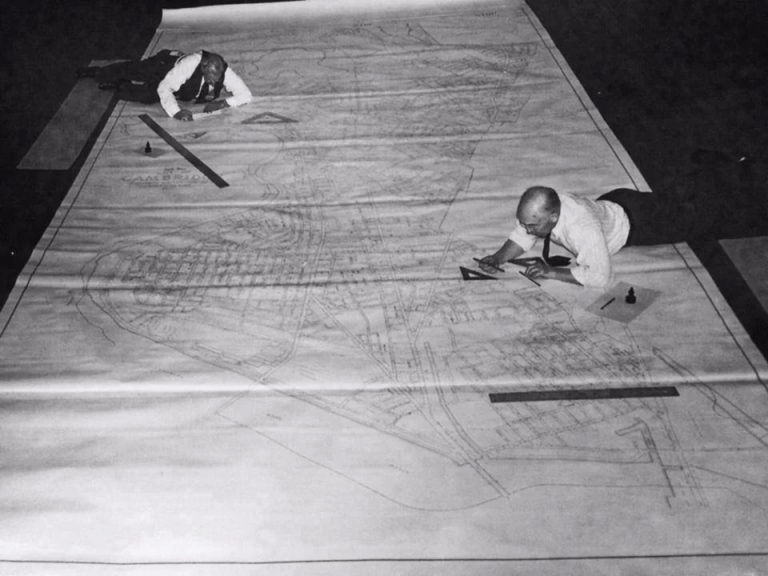
They had completed perspective drawings by placing rulers against the paper, drawing lines in one-point and two-point perspective, and adding shadows.
That had been the era when architectural drafting truly was essential.
Because of that, Seung Yugyeol had even experienced the nightmare of making a tiny mistake in one insignificant area and having to start the entire work again from the beginning.
But even back then…
Professor Seung had never seen a work like this.
Even among the works of the brilliant seniors he had admired, this was the first time he had seen something produced at this level.
More than that, wasn’t this work showing something beyond the mere act of “architecture”?
‘Have I ever tried to deliver a message like this through architecture?’
And that message was expressed just as effectively in the model.
The model, measuring no more than 90 centimeters in width, length, and height, recreated the entire view of the memorial park depicted in the panel.
But after examining the model carefully, the judges soon stared in surprise.
“Wait, the materials for this model…. It’s made from discarded materials and trash someone threw away, isn’t it?”
When Geonshin made the model, he had collected discarded materials and trash piled up in the stairwell and used them to construct it.
Had this been a submission for an actual design competition, it would have been an absurdly reckless choice.
Strictly speaking, however, the Korea Architecture Competition judged architecture that would not actually be constructed.
Geonshin believed that although the details of the model were certainly important, there was no problem with using those materials as long as they reflected the work’s intent.
Memorial Park was a place for leaving behind the traces of a disaster.
Rather than making everything from pristine new materials, Geonshin believed that broken and discarded materials being reborn with new meaning was more than sufficient to convey his sense of the problem to the judges.
In the end, Geonshin’s submission, [Seocho-dong 1685-3], made the screams of the Sampoong Department Store disaster echo from one corner of the judging hall.
Do not turn a blind eye…
And that intention put the judges in an uncomfortable position.
They had encountered one of the most controversial works in the history of the architecture competition.
The other entries no longer meant anything to them.
Now that they had seen Geonshin’s work, they had to make a choice.
Would they bury the memory of the tragedy now that it had finally grown quiet again?
Or would they use this opportunity to bring it back to the surface?
“Won’t choosing this just create problems for no reason?”
“I know. Construction is already well underway….”
“It doesn’t seem like the issues with the memorial hall and compensation have even been fully resolved yet. If we stir everything up again for no reason….”
One by one, they began to move away from the work.
Professor Kim looked at Seung Yugyeol.
“Hmm. What are you going to do?”
In truth, Seung Yugyeol felt miserable standing before Geonshin’s work.
Looking at it had brought back a memory he had buried because he could not bear his own shame at the time.
What had made him ashamed?
It was not as though he had designed Sampoong Department Store.
Nor had he supervised its construction.
And yet he had his own reasons.
After the Sampoong Department Store disaster, the term that rose to the forefront was “shoddy construction”.
As the issue gained attention, Seung Yugyeol, one of the most prominent architects in the industry at the time, naturally began receiving interview requests regarding the tragedy.
Most came from newspapers asking for his views on corruption in construction companies.
Even before agreeing to an interview, Seung Yugyeol could already predict what they wanted him to say.
They would use his expertise and present him as an honest architect, and in exchange they wanted him to throw them a lead they could use to investigate corrupt construction companies.
But at the time, the government building whose construction he was overseeing was being built by Kiyeong Construction, one of Korea’s leading conglomerates.
From Seung Yugyeol’s position, he was not in a situation where he could freely speak his mind about the issue.
If even one problem arose, the government building’s construction schedule could be delayed.
Worse, if the corruption at Kiyeong Construction that he himself knew about came to light, it would become an enormous headache.
And so he refused every interview and hid himself away.
That had been the choice made by the country’s leading architect at the time.
Of course, even if he had worked tirelessly to expose their corruption, the future of the Sampoong Department Store site probably would not have changed.
At most, the apartment complex standing there would simply have been built by a different company instead of the one currently handling the construction.
But today, as he looked at Geonshin’s work….
Faced with its sincerity, Seung Yugyeol could no longer hide his shame.
At the very least, this work was saying that what had happened was wrong.
Because there was an enormous difference between silently allowing the mistakes of an era to pass and sharing them so that people could reflect upon them.
The finest architect in the country, shrinking endlessly before a student’s work….
He gave a hollow laugh.
And Professor Kim watching beside him was not much different from Seung Yugyeol.
He too had been someone who avoided the issue.
He could not easily escape that sense of guilt either.
The more they reflected on the work, the more its bitter aftertaste refused to disappear.
Everyone in the judging hall felt the same.
Still, Seung Yugyeol was, strictly speaking, the chair of this year’s Korea Architecture Competition judging panel.
In terms of quality, idea, attitude, and expressive power, not a single aspect of Geonshin’s work fell outside award-winning territory.
But that was a separate matter.
Placing a sticker on this work would also mean exposing the mistake he himself had once chosen to ignore.
‘If I could go back to that time again, would I hide myself once more…?’
He quietly looked down at the sticker in his hand.
Then, as though he had made a decision, he raised his head.
Notes:

In the Mona Lisa, you can see that in all three points on her face, the technique of sfumato is illuminated as the contrast between her hair and her face is merged together in a hazy, gradient like shading. (Source)

Leave a Reply